Knowing how to calculate delivery driver net pay is the difference between an app that pays and one that quietly costs you money.
Below you get the formula, the four costs most drivers forget, and a worked example you can copy.
Read to the end and you will be able to price any shift before you accept it.
How to calculate delivery driver net pay: the formula
Delivery driver net pay equals what the app paid you plus tips, minus your vehicle costs, minus the taxes you owe as a self-employed worker, divided by the hours you were actually working, including time waiting for orders. Gross pay is the number the app shows; net pay is what you keep.
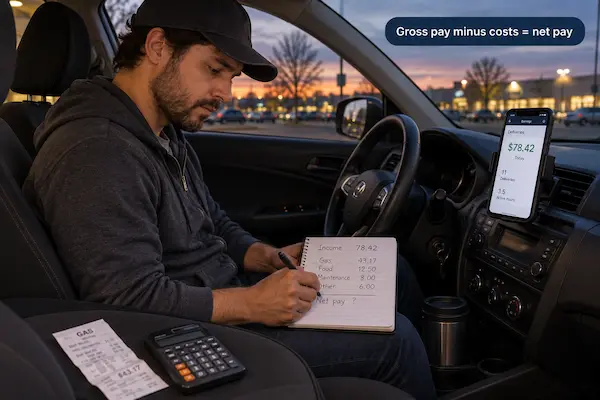
Written out, the formula looks like this:
| Line | What goes in it |
|---|---|
| Gross pay | Base pay, promotions, bonuses and tips |
| Minus vehicle costs | Fuel, maintenance, tires, depreciation, insurance share |
| Minus other costs | Phone data, parking, tolls, hot bags, supplies |
| Minus taxes | Self-employment tax plus income tax on net profit |
| Divided by hours | Every hour online, not only hours on a delivery |
The tax line is the one most drivers skip, and the Internal Revenue Service (IRS) is clear about it. In its gig economy guidance, the IRS says you must report income from gig work on a tax return. That applies even if it is not reported on a form such as a 1099-K or 1099-NEC. If your net earnings from self-employment reach 400 dollars or more, you must file and pay self-employment tax. That tax is 12.4 percent for Social Security and 2.9 percent for Medicare, according to IRS Topic 554, and it comes on top of regular income tax.
Once every line is filled in, the hourly number often looks very different from what the app advertised. The next section shows why that matters for the choices you make every day.
What changes when you track real net pay
When you know your true hourly net, you stop accepting orders that lose money. You start choosing zones, hours and platforms by what they actually leave in your pocket. Gross pay makes every order look the same; net pay shows the long, low-tip trip for what it is.
Illustrative example: a driver sees 22 dollars an hour on the app screen for a four-hour evening and feels good about it. She drove 60 miles. Using the IRS standard mileage rate as a proxy for vehicle cost, those miles are worth more than 45 dollars in expenses. After setting aside roughly 15 percent of profit for self-employment tax, her four hours netted closer to 9 dollars an hour. The following week she works a denser zone with shorter trips, drives 35 miles for the same gross, and nets almost twice as much per hour.
The IRS standard mileage rate is useful here for two reasons. First, it is the figure the IRS lets self-employed drivers deduct per business mile instead of tracking every receipt. Second, it is a fair rough estimate of what a mile really costs in fuel, wear and depreciation. The IRS updates the rate at least once a year and publishes it on its standard mileage rates page; the rate in effect for the second half of this year is 76 cents per mile for business use.
✅ Tip: log your miles every shift with a mileage app or a notebook. The IRS says to collect and keep records and receipts during the year, and mileage is usually the single biggest deduction a delivery driver has.
Mileage is only the largest of several costs that shrink gross pay. The next section lists the rest so nothing gets left out of your calculation.
The costs that separate gross from delivery driver net pay
Four groups of costs sit between gross and delivery driver net pay: vehicle costs per mile, fixed costs you pay whether or not you drive, unpaid time, and taxes. Each one is easy to underestimate.
Vehicle costs per mile
Fuel is the visible cost, but maintenance, tires, oil changes and depreciation add up quietly. If you do not want to track each receipt, use the IRS standard mileage rate as your per-mile estimate. Multiply it by the miles driven for deliveries, including the miles back from a drop-off with no new order.
Fixed costs
Your phone plan, a portion of your car insurance, and any commercial or rideshare insurance rider exist whether you deliver or not. Divide the monthly total by the hours you work in a month to see how much each hour carries. Parking fees and tolls belong here too when the app does not reimburse them.
Unpaid time
Time spent waiting for an order, driving to a busier zone, or standing in line at a restaurant is work time with no pay attached. Counting only the minutes on an active delivery inflates your hourly rate. Track the moment you go online to the moment you go offline.
Taxes
As an independent contractor you report income and expenses on Schedule C and pay self-employment tax on Schedule SE, according to the IRS gig work guidance. The IRS also expects quarterly estimated payments with Form 1040-ES, due in April, June, September and January. Setting money aside each week avoids a painful bill in the spring.
With all four groups in view, you can build a simple calculator that gives you the real number after every shift.
How to build your own delivery driver profit calculator step by step
You need a spreadsheet or a notes app, your app earnings history, an odometer reading at the start and end of each shift, and the current IRS standard mileage rate.
- 1Record gross pay for the shift: base pay, promotions and tips as shown in the app’s earnings tab.
- 2Log total miles from the odometer, online to offline, and multiply by the IRS mileage rate to estimate vehicle cost.
- 3Add fixed and other costs for the shift: the hourly share of phone and insurance, plus parking, tolls and supplies.
- 4Subtract costs from gross to get profit before tax, the number that feeds Schedule C.
- 5Set aside taxes: a share of that profit for self-employment tax and income tax, based on the IRS rates and your own bracket.
- 6Divide by hours online to get your net hourly rate, and compare it shift by shift, zone by zone, app by app.
Common errors: counting only active delivery time, using fuel alone as the vehicle cost, and forgetting that tips are taxable income too. If your net hourly rate is below what a local hourly job pays, the data is telling you to change zones, hours or platforms, not to drive more miles.
Frequently asked questions about delivery driver net pay
Straight answers to the questions drivers ask when they first compare gross and net.
What is a good net pay per hour for a delivery driver?
There is no official benchmark, because it depends on your city, vehicle and hours. A practical test is to compare your net hourly rate after mileage and taxes with the wage of a local hourly job you could take instead. If delivery nets less, the flexibility is what you are paying for.
How much should a delivery driver set aside for taxes?
Self-employment tax alone is 12.4 percent for Social Security plus 2.9 percent for Medicare on net earnings, per the IRS. Income tax comes on top and depends on your total household income. Many drivers set aside a fixed share of profit each week and confirm the amount with a tax professional or the IRS estimator.
Do I pay taxes on delivery income if I never got a 1099?
Yes. The IRS states that gig income must be reported even when it is not shown on a Form 1099-K, 1099-NEC or any other statement, and even when it is paid in cash or through an app. Keep your own records so the total is right.
Is a delivery driver profit calculator app worth it?
A mileage tracking app is worth it because it captures the deduction the IRS lets you claim. A profit calculator is a convenience; a spreadsheet with the six steps above does the same job for free, as long as you fill it in after every shift.
Can I deduct my car if I also use it personally?
You can deduct the business portion. With the standard mileage method, that means only the miles driven for deliveries, so a clean mileage log is essential. The IRS points self-employed workers to Publication 463 for vehicle expense rules.
How we checked this information
The tax facts in this guide come from the Internal Revenue Service: the Gig Economy Tax Center, which states that gig income must be reported even without a Form 1099; the Manage taxes for your gig work page, which sets the 400 dollar filing threshold, names Schedule C, Schedule SE and Form 1040-ES, and lists the quarterly due dates; Tax Topic 554 for the self-employment tax rates; and the IRS standard mileage rates page for the current business rate.
We did not quote average earnings for any delivery platform, because those figures come from company marketing or unverified surveys and change constantly. The example in this article is hypothetical and labeled as such. This site is independent and has no relationship with any delivery platform or with the IRS.
Nothing here is tax advice. Your own situation, including state taxes and other income, changes the result, so confirm your numbers with a tax professional or the official IRS tools before filing.
Run the numbers on your next shift
You now know how to calculate delivery driver net pay: gross pay, minus mileage and other costs, minus a tax reserve, divided by every hour online. Start tonight by writing down your odometer reading before you go online and again when you log off.
After five shifts you will have a net hourly rate for each zone and time slot you tried. That single number tells you where to drive, when to stop, and whether the next promotion is worth chasing. Keep the log, keep the receipts, and let the real number decide.
ℹ️ Important: this is an independent informational site, not affiliated with any government agency or company mentioned. This article is general information, not tax or financial advice. Tax rates, mileage rates and deadlines change; confirm current figures on irs.gov or with a qualified tax professional.