The documents needed for utility assistance are mostly papers you already have at home: ID, income proof and your bill.
Below you get the full checklist, what counts as proof of income, and the one paper most people forget.
Read to the end and you can put the whole folder together tonight, before the office opens.
Documents needed for utility assistance: the checklist
To apply for utility assistance, you generally need proof of who you are, proof of where you live, proof of everyone in your household, proof of income for the whole household, and a recent copy of your energy bill. If you received a shutoff notice, bring that too.
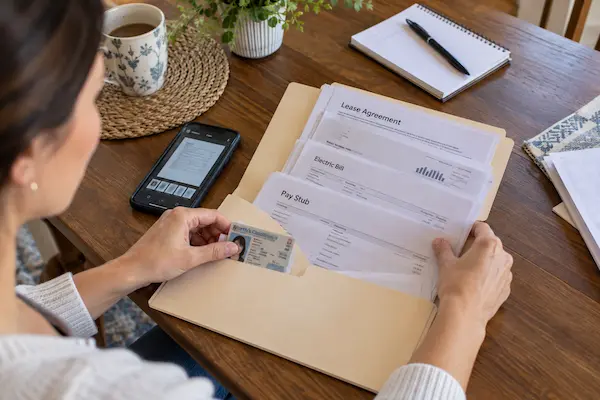
The main federal program behind this help is the Low Income Home Energy Assistance Program (LIHEAP). It is funded by the U.S. Department of Health and Human Services (HHS) and run by state, tribal and territorial agencies. Because each state runs its own version, the exact list varies a little. The list below comes from the official LIHEAP brochure published by the HHS Office of Community Services, which says you “may need the following.”
State lists follow the same pattern. Illinois, for example, asks for proof of the past 30 days of income and a heating or electric bill issued within the last 30 days. It also lists Social Security cards or ITINs for those who have them, a rental agreement when heat is included in rent, and proof of other benefits such as SNAP. Illinois also notes that residents without a Social Security number or ITIN can still apply.
A full folder is not just about being organized. It can decide how fast the money reaches your account, as the next section shows.
Why a complete folder can mean help before the shutoff
A missing document is the most common reason an energy assistance application stalls, and a stalled application does not stop a disconnection date. The HHS brochure warns that assistance is not guaranteed and that federal funds are often used up during the winter months, so applying early and complete matters.
Illustrative example: a father of two gets a termination notice with a date twelve days away. He applies the same afternoon, but the office asks for a pay stub from the last 30 days and his only stub is two months old. He waits for the next payday, returns, and by then the office has a backlog. With a current stub on day one, his file would have moved straight to review.
The lesson is simple. The office cannot review what it does not have. Every gap in your folder becomes a second visit, a phone call, or a letter asking for more, and each of those adds days.
⚠️ Watch out: the official program never charges an application fee. If a website or caller asks you to pay to “process” your energy assistance, it is not the program.
The document that trips up most applicants is proof of income, because it means different things for different households. The next section clears that up.
What counts as proof of income for utility assistance
Proof of income for utility assistance is any official paper that shows the gross money each adult in the home received in the recent period the agency asks about, most often the last 30 days. Gross means before taxes and deductions. Every adult counts, not just the person whose name is on the bill.
The forms of proof most state programs accept follow the HHS brochure and typical state guidance:
- Pay stubs covering the requested period, or an employer letter showing gross pay.
- Award or benefit letters for Social Security, SSI, unemployment insurance, pensions or disability.
- Child support or alimony records.
- For self-employed people, recent records of earnings or the latest tax return, depending on the state.
- A signed statement of no income, when an adult in the household earned nothing, if your state accepts it.
Eligibility is set by your income compared with limits your state chooses. The HHS LIHEAP page explains that states use the federal poverty guidelines and state median income to set those limits, and the exact cutoff changes every year. Instead of trusting a number you saw online, check the current table on your state’s LIHEAP page or ask the local agency.
Some households qualify through another benefit. Illinois, for example, asks for proof of TANF, SNAP or medical assistance when the household already receives it, because that proof can shorten the income review. With proof of income sorted, the rest of the folder comes together fast.
How to prepare your energy assistance documents step by step
You need about an hour, a folder or a phone with a scanner app, and the name of the agency that takes applications in your county.
- 1Find your local agency through your state’s LIHEAP office or the National Energy Assistance Referral line at 1-866-674-6327, run for HHS.
- 2Download the state’s own checklist and note the income period it asks for, usually 30 days, sometimes 12 months.
- 3Collect ID and household proof: photo ID for the applicant and Social Security cards or numbers for everyone in the home.
- 4Print or save income proof for every adult, covering the full period, plus benefit letters and child support records.
- 5Add the energy bills, both heating and electric if they are separate, showing your name, account number and service address.
- 6Include your lease or address proof, and the shutoff notice if you have one, since it may move you into crisis assistance.
- 7Submit the way your agency requires: online, by mail or in person, and write down the date and any confirmation number.
Common errors: sending a bill in a roommate’s name, forgetting income for an adult child who lives with you, and using a pay stub from outside the requested period. If the agency asks for something more, send it the same day and keep a copy of everything you hand over. If you are denied, the letter should explain why and how to appeal; a missing paper is often fixable.
Frequently asked questions about energy assistance paperwork
Straight answers to the questions people ask before they walk into the office.
What documents do I need for energy assistance if I have no income?
You still need ID, household proof, address proof and your bill. For income, most states accept a signed statement of zero income or ask how you cover expenses. Check the exact form your state uses, because some require a specific declaration.
Do I need a Social Security number to apply for utility assistance?
The HHS brochure lists Social Security cards or numbers for household members as something you may need. Rules differ by state; Illinois, for example, states that residents without an SSN or ITIN can still apply. Ask your local agency what applies to you.
Can I apply if the utility bill is not in my name?
Often yes, but you may need extra proof, such as a lease showing that heat is included in your rent and your landlord’s contact information. Illinois asks for exactly that when heating is part of the rent.
How recent does my proof of income have to be?
Most agencies ask for the last 30 days, and some look at a longer period. The HHS brochure says a recent payroll stub showing current gross income. Use the newest documents you have and bring the period your state names.
Is a shutoff notice required to get help?
No. Regular assistance helps with heating or cooling bills without a notice. A termination notice matters for crisis assistance, which HHS describes as emergency help during an energy crisis, so bring it if you have one.
How we checked this information
The checklist in this guide comes from the LIHEAP brochure published by the Office of Community Services at HHS, which lists the documents applicants may need and the referral line for finding a local agency. Program basics, including who administers LIHEAP and how eligibility is set, come from the HHS LIHEAP program page and the USA.gov page on help with energy bills, which notes that some offices accept online applications while others require in-person visits.
To show how a state list looks in practice, we read the Illinois Department of Commerce and Economic Opportunity’s “How to apply” page for its utility bill assistance program. We did not quote income limits or benefit amounts, because those change every year and differ by state; your state’s LIHEAP office has the current figures.
This site is independent and is not connected to HHS, any state agency, or any utility company. When a rule in your state differs from what you read here, the state’s instructions win.
Walk in with everything and apply once
You now have the documents needed for utility assistance in one list: ID, Social Security numbers, address proof, household proof, income proof for every adult, your energy bills and any shutoff notice. Put them in a folder tonight, take photos as a backup, and contact your local agency tomorrow.
One complete application beats three incomplete ones. If you are not sure whether your income fits, apply anyway; the agency decides, and the worst outcome is a letter that tells you why. Keep this checklist for next season, because most states ask for the same papers every year.
ℹ️ Important: this is an independent informational site, not affiliated with any government agency or company mentioned. Eligibility is decided by your state program; you may qualify based on your income and household, but nothing here is a guarantee. Confirm documents and deadlines with your local energy assistance office.