How much do Instacart shoppers make depends less on the batch pay you see and more on what comes off it afterward.
Below you will see how Instacart builds each payout, which costs are yours, and how to find your real hourly rate.
Read to the end and you will be able to judge any batch in ten seconds before you accept it.
How much do Instacart shoppers make: how pay is built
Instacart shoppers make a batch payment from Instacart plus the full tip from the customer, with occasional boosts on top, and nothing is deducted for taxes or expenses before the money reaches them. Instacart’s shopper earnings page says batch pay reflects the total expected effort to complete a batch, including travel to the store and to the customer, the quantity and weight of items, and the expected shopping time.
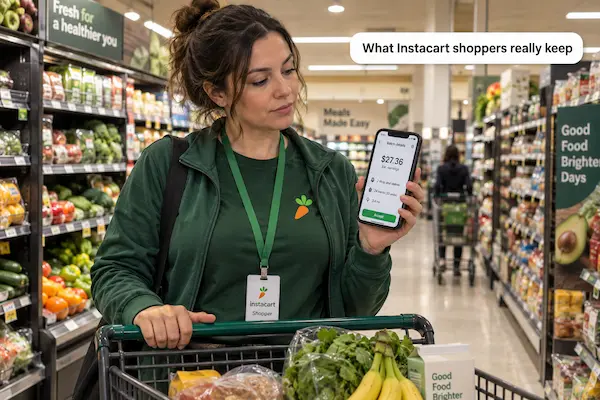
Here is what each part of a payout is and where it comes from, according to Instacart’s own description.
| Part of the payout | What decides it |
|---|---|
| Batch pay | Distance, number of items, expected shopping time |
| Customer tip | Set by the customer; shoppers get 100 percent |
| Boosts | Extra pay when an area lacks shoppers |
| Tip protection | Instacart covers removed tips up to 10 dollars in some cases |
| State guarantees | In California, a weekly minimum plus a per-mile amount |
Instacart states that shoppers always get 100 percent of the tips customers give, and that if a customer removes a tip without reporting an order problem, Instacart covers the removed amount up to 10 dollars. In California, Instacart says shoppers are guaranteed at least 120 percent of the local minimum wage for time spent shopping and delivering, plus 30 cents per mile, calculated weekly, with tips paid on top. That guarantee does not exist in most other states. What every state shares is the list of costs in the next section.
The costs that come out of Instacart shopper pay
The costs that come out of Instacart shopper pay are the ones no app shows you: fuel, wear on your car, your phone plan, self-employment taxes and any cash-out fees, because Instacart treats full-service shoppers as independent contractors who cover their own expenses. The gross number in the app is not the number you keep.
Taxes deserve the most attention because they arrive months after the money was spent. The Internal Revenue Service (IRS) says you must file a return if you have net earnings from self-employment of 400 dollars or more, even from a part-time or temporary side job. Contractors report on Form 1040 with Schedule C and Schedule SE, and estimated payments may be due four times a year.
The IRS also allows a deduction for business use of your car. Its standard mileage rate, which it updates periodically, was 76 cents per mile at the time of writing. That figure matters twice: it lowers your taxable income, and it is a fair estimate of what each mile really costs you in fuel and wear. Keep a mileage log from day one.
ℹ️ How we checked this information: pay structure facts come from Instacart’s shopper earnings page and its California guaranteed earnings notice; tax facts come from the IRS gig economy guidance and the IRS standard mileage rate page. This is general information, not tax advice; confirm your situation with the IRS or a tax professional.
What a real week looks like after costs
After costs, a real week of shopping is usually smaller than the app total by the price of the miles driven and the share set aside for taxes, and the gap grows with every long delivery. Seeing that gap on paper, before you commit your evenings, is what separates shoppers who stay from shoppers who quit in month two.
Illustrative example: a shopper works 20 hours in a week and the app shows 400 dollars in batch pay and tips. She drove 300 miles. At the IRS mileage figure of 76 cents, those miles represent about 228 dollars of car cost and tax deduction, leaving roughly 172 dollars of net profit before tax, or under 9 dollars an hour. A second shopper works the same 20 hours for the same 400 dollars but stays close to the store, drives 120 miles, and keeps about 309 dollars before tax, about 15 dollars an hour.
The numbers are invented for the example, but the mechanism is not: distance is the single cost that changes the result most, and it is the one you can see before accepting a batch. That is also why long batches with small tips are the ones experienced shoppers skip.
⚠️ Watch out: set money aside for taxes from the first payout. The IRS expects contractors to pay as they earn through estimated payments, and a bill in April for a full year of untaxed batches is the most common reason new shoppers end a good year in the red.
The good news is that once you know your per-mile cost and your tax share, judging a batch becomes arithmetic. The next section turns it into a routine you can run in the parking lot.
How to calculate your Instacart earnings per hour
You need three tools: the trip odometer or a mileage app, a note where you log each batch, and the current IRS mileage rate. With those, the calculation takes a minute at the end of each shift.
- 1Log the start time and odometer the moment you go online, not when you accept the first batch.
- 2Record each batch with batch pay, tip and boost as separate lines, exactly as the app shows them.
- 3Close the shift with the end time and odometer, and subtract to get total hours and total miles.
- 4Multiply miles by the IRS rate and subtract that from gross pay to get your profit before tax.
- 5Set aside your tax share of that profit in a separate account, at a percentage you have confirmed with the IRS guidance or a tax professional.
- 6Divide what is left by hours online. That is your real hourly rate; compare it week to week and against the local job you could take instead.
The most common mistake is counting only the time inside the store, which makes the rate look better than it is. The second is using gas receipts instead of miles; gas is only part of the per-mile cost. The third is skipping the log on good days and only tracking bad ones, which hides the true average.
Frequently asked questions about Instacart shopper pay
How much can you make on Instacart in a week?
Instacart does not publish an average, and it depends on your market, hours, distance and tips. The only reliable number is the one you calculate from your own log after miles and taxes.
Do Instacart shoppers keep all of their tips?
Yes. Instacart’s earnings page states that shoppers always get 100 percent of the tips customers give, and that removed tips are covered up to 10 dollars when the customer did not report an order issue.
What are Instacart earnings per hour after gas?
Subtract miles driven times the IRS standard mileage rate from your gross, then divide by hours online. Gas alone understates the cost; the IRS rate includes wear and depreciation.
Does Instacart take taxes out of shopper pay?
No. Full-service shoppers are independent contractors, and the IRS says they must report the income and may need to make estimated payments during the year. Setting money aside each week avoids a surprise bill.
How is Instacart shopper pay different in California?
Instacart says California shoppers are guaranteed at least 120 percent of the local minimum wage for engaged time plus 30 cents per mile, checked weekly, with tips on top. Other states have no such floor unless local law adds one.
How this site helps you compare gig work honestly
This site’s Productivity section covers side income from the perspective of what you keep, not what an app advertises. Delivery and shopping platforms are a large part of that, and every guide follows the same rule: pay structure from the company’s own pages, costs from the IRS, and no invented averages.
Around this article you will find guides on other delivery platforms, on choosing between in-store and driving roles, on budgeting irregular income, and on planning a week that fits gig hours around a main job. Each one names its sources in the text so you can check them.
We are not connected to Instacart or to any platform, and we do not earn referral fees for sign-ups. The goal is simply that you decide with the real numbers in front of you.
Track one full week before you decide
You asked how much do Instacart shoppers make, and the honest answer is that it is your gross minus your miles and your taxes, a number only your own log can produce. The structure is clear: batch pay for effort, 100 percent of tips, occasional boosts, and every expense on your side of the ledger.
Run the six-step calculation for one full week, including slow days, before judging the work. If the hourly rate after costs beats your alternatives, keep going and keep logging. If it does not, you have learned that for the price of one week instead of one year. Either way, keep the mileage log; the IRS deduction is the one cost you can get back.
ℹ️ Important: this is an independent site, not affiliated with any government agency or company mentioned, including Instacart. Content is informational only and is not tax or financial advice. Pay structures, fees and tax rates change; confirm details on Instacart’s official shopper pages and with the IRS or a tax professional.