Wondering how to pay for CNA classes? There are five realistic ways, and two of them may cost you nothing.
One of those two is written into federal nursing home rules, and most students have never heard of it.
Read to the end and you will know which option fits you and the exact order to try them in.
How to pay for CNA classes: the five ways at a glance
You can pay for CNA classes through a nursing home that trains you for free, a federal reimbursement rule if you get hired within 12 months, workforce funds from your local American Job Center, financial aid at a community college, or a payment plan or scholarship from the school itself. Which one fits depends on whether you already have a job offer and how soon you want to start.
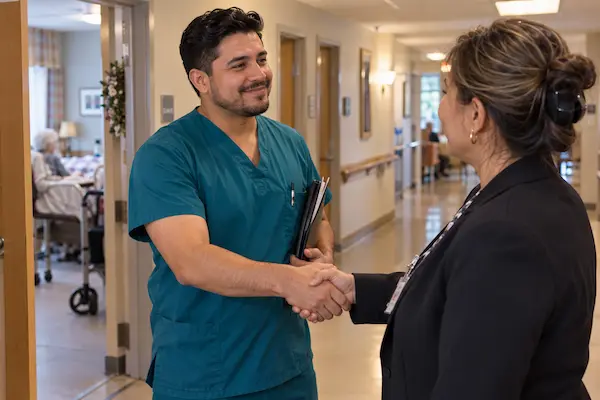
A CNA (certified nursing assistant) completes a state-approved training program and passes a state competency test before working. The U.S. Bureau of Labor Statistics (BLS) states that the program includes classroom instruction and supervised clinical work. Length and cost vary by state and school.
Here is the ranking in one table, ordered by how little you are likely to pay.
| Way to pay | What you pay |
|---|---|
| 1. Facility-sponsored training | Nothing, under federal rules |
| 2. Reimbursement after hire | Upfront, then repaid pro rata |
| 3. WIOA workforce funds | Often nothing, if approved |
| 4. Financial aid at a college | Part or all, by eligibility |
| 5. School payment plan or scholarship | Full cost, spread out or reduced |
The first two options come from the same federal regulation, 42 CFR 483.152, which governs nurse aide training tied to Medicare and Medicaid nursing facilities. Before the details, consider what a free or reimbursed program changes for you.
What changes when CNA training does not come out of your pocket
When someone else covers the class, the decision to start stops being a money question and becomes a scheduling question. You can begin in the next available cohort instead of saving for months.
Illustrative example: a 24-year-old working retail wants to move into healthcare but has no savings for tuition, uniforms, and the state test fee. Every month of waiting is another month at the same wage.
Now imagine she applies to a nursing home that runs its own training class. Because she is hired before the class starts, federal rules say she cannot be charged for any part of the program. Weeks later she is a working CNA. The bridge between the two scenes was knowing that facility-sponsored training exists and asking for it.
The job side of this picture is steady. BLS projects that employment of nursing assistants and orderlies will grow about as fast as the average for all occupations, with roughly 203,300 openings each year on average over the decade, many from workers who retire or change careers. BLS reports a median annual wage of $42,260 for nursing assistants in its most recent data. That is why facilities are willing to train: they need people.
⚠️ Attention: free training from an employer often comes with a work commitment or a repayment clause if you leave early. Read the agreement before you sign, and ask what happens if you do not pass the state test on the first try.
With the “why” clear, here are the five options in detail, in the order you should try them.
The five ways to pay for CNA training, ranked
The ranking starts with the option most likely to cost nothing. Try them in order and stop at the first one that works.
1. CNA training paid by employer (facility-sponsored classes)
Some nursing facilities run their own state-approved training programs or partner with a local school. Federal regulation 42 CFR 483.152 states that a nurse aide who is employed by, or has received an offer of employment from, a facility on the day the training program begins may not be charged for any portion of the program. In plain terms: get the job first, and the class is free.
2. Reimbursement if you are hired within 12 months
If you paid for training yourself and then get hired by a nursing facility within 12 months of completing the program, the same regulation says the state must provide for reimbursement of your costs on a pro rata basis during the period you are employed as a nurse aide. Keep every receipt and ask the facility’s HR office how to request it; the process varies by state.
3. Workforce funds through your American Job Center
The Workforce Innovation and Opportunity Act (WIOA) funds job training for eligible adults through American Job Centers. The U.S. Department of Labor states that the WIOA Adult program gives priority to recipients of public assistance, low-income individuals, and people who lack basic skills, and that veterans receive priority of service. CNA programs are common on state-approved training lists; the center can tell you whether your chosen school qualifies.
4. Financial aid for CNA programs at community colleges
Some community colleges offer CNA training as a credit course or as part of a certificate, and some of those programs may be eligible for federal or state financial aid. Eligibility depends on the school, the program’s length, and your own situation. Ask the school’s financial aid office directly whether the CNA program qualifies before you assume it does.
5. Payment plans, scholarships, and employer tuition help
If none of the above applies, ask the school about installment plans and local scholarships, and check whether your current employer offers tuition assistance. This route costs the most, but it leaves door number two open if a facility hires you within a year.
The other half of the job is the order of phone calls, and that is the next section.
How to get your CNA classes paid for step by step
Before you start, confirm your state’s basic requirements for nurse aide training, such as minimum age and background check, so you do not apply to a program you cannot enter.
- 1Call nursing homes near you and ask two questions: “Do you offer paid CNA training?” and “Do you hire trainees before class starts?” A yes to both means option 1.
- 2Visit your American Job Center if no facility is hiring trainees, bring proof of income or benefits, and ask about WIOA training funds for a state-approved CNA program.
- 3Ask the college’s financial aid office whether its CNA program is aid-eligible and what forms you need to file.
- 4Compare total cost, including the state test fee, uniforms, and background check, before choosing a payment plan or scholarship.
- 5Keep every receipt if you pay anything yourself, so you can request pro rata reimbursement if a nursing facility hires you within 12 months.
- 6Enroll only in a state-approved program, because training that is not approved will not qualify you for the state test or for reimbursement.
Common mistakes: paying a deposit to an unapproved “fast” program, signing an employer agreement without reading the repayment clause, and forgetting the 12-month reimbursement window. If a facility turns you down, ask when the next class starts.
Frequently asked questions about free CNA classes and financial aid
Are free CNA classes really free, or is there a catch?
Facility-sponsored classes are free under federal rules for people employed by or offered a job at the facility when training begins. The usual catch is a work commitment or a repayment clause if you leave early, so read the agreement.
Can I get CNA training paid by employer if I have no healthcare experience?
Yes. Facility-sponsored training is designed for people entering the field. Facilities typically look for reliability, a clean background check, and the physical ability to do the work, not prior experience.
Is there financial aid for CNA programs that are only a few weeks long?
Sometimes, but not always. Short programs may not meet the length rules for federal student aid. WIOA funds through an American Job Center and school scholarships are more common for short CNA programs. Ask the school and the center.
I already paid for CNA classes. Can I get the money back?
Possibly. Under 42 CFR 483.152, if a Medicare or Medicaid nursing facility hires you within 12 months of completing the program, the state must provide for pro rata reimbursement of your costs while you work there. Ask the facility’s HR office how to file.
Who qualifies for WIOA money for CNA training?
The U.S. Department of Labor says the WIOA Adult program prioritizes public assistance recipients, low-income individuals, and people lacking basic skills, with priority of service for veterans. Local rules vary, so the American Job Center makes the final call.
How this site helps you start a healthcare career
Our Career & Education section focuses on jobs you can enter quickly with short training, and on the money questions that stop people from starting. Becoming a CNA is one of the most common entry points into healthcare, and the funding rules above are the difference between “someday” and “next month.”
We cover the practical side: what the training involves, how to find approved programs, and how to move from CNA into other roles later. Each guide names the exact offices and rules to ask about.
✅ How we checked this information: the free-training and 12-month reimbursement rules come from 42 CFR 483.152(c) on the Electronic Code of Federal Regulations. The WIOA priority groups come from the U.S. Department of Labor’s WIOA Adult program page. Training requirements, wage, and job outlook figures come from the BLS Occupational Outlook Handbook entry for nursing assistants and orderlies.
Your state’s nurse aide registry or health department is the final authority on approved programs and reimbursement procedures.
Pick your option and start your CNA training
You came here asking how to pay for CNA classes, and now you have five answers in the right order: sponsored training first, reimbursement second, workforce funds third, financial aid fourth, payment plans last. The cheapest options are also the fastest, because they start with a job.
Today, list three nursing facilities within driving distance and call each one about sponsored training. If none is hiring, find your nearest American Job Center. Then keep reading our Career & Education guides to prepare for the training itself and the state test that follows.
ℹ️ Important: en.amucc.com.br is an independent informational site, not affiliated with any government agency or company mentioned, including the U.S. Department of Labor, BLS, or any school or nursing facility. Eligibility for funding is decided by each program; you may qualify, but nothing here is a guarantee. Confirm current rules with your state and the program before enrolling.