Learning how to spot text scams comes down to five red flags you can check in ten seconds, before you tap anything.
You will see real smishing examples, the exact words scammers use and what to do if you already clicked.
Read to the end for the step by step and the answers to the questions people ask most.
How to spot text scams: the five red flags
A text is almost certainly a scam if it arrives unexpectedly, creates urgency and asks for personal or payment information. An unfamiliar link and an unknown sender complete the picture.
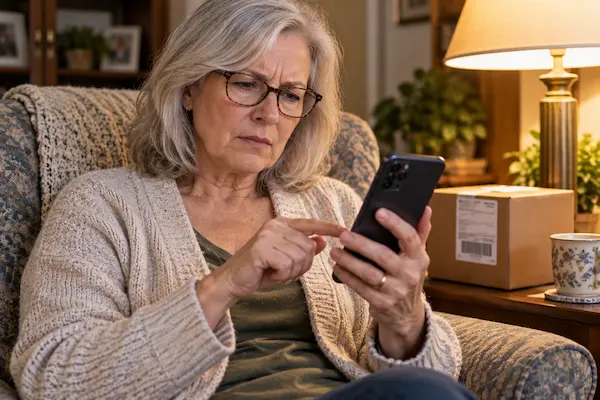
The Federal Trade Commission (FTC), the U.S. agency that tracks consumer fraud, puts it plainly: legitimate companies will not ask for information about your account by text. That single rule filters out most fake messages. A real bank, delivery company or government agency may notify you. It will send you to the app or website you already use, not to a strange link.
Scammers rely on the opposite of that. They want you to react before you think. The five signs below are the ones the FTC repeatedly warns about, arranged so you can run through them in order.
One flag is suspicious. Two or more together are close to certain. Understanding why these tricks work on smart people is the best defense, and that is the next section.
Why one tap can cost you more than you think
A scam text is designed to skip your judgment: it hits during a busy moment, names something you care about and gives you one easy action.
Illustrative example: you are waiting for a package. A text says a delivery failed and asks you to confirm your address through a link. The page looks like the carrier’s site and asks for a small redelivery fee by card. You pay a couple of dollars. The scammer now has your card number, your address and proof that you respond to texts, which makes you a target for the next round.
The FTC describes this exact pattern. Fake delivery notices, fake account alerts about suspicious activity, fake prize offers and fake loan help are among the most common scam texts it lists. None of them need you to be careless. They only need you to be in a hurry.
The damage is rarely just the first payment. Stolen logins get reused on other accounts, and a phone number that responds gets sold to other scammers. That is why the smartest response is not to argue with the text or reply “STOP” to an unknown sender. It is to not engage at all.
🚫 Do not reply, even to say “stop”: a reply confirms your number is active. Delete the message or report it instead.
Knowing the pattern makes the examples easier to recognize. Here are the versions you are most likely to see on your own phone.
Smishing examples: fake text messages you will actually receive
Smishing is phishing by SMS, and the most common fake text messages imitate delivery companies, banks, government agencies, toll authorities and employers.
The wording changes, but the structure stays the same: a familiar name, a problem or a reward, and a link. The table shows the typical message and what the scammer is really after.
| Fake text | What it wants |
|---|---|
| “Your package could not be delivered” | Card number for a fake redelivery fee |
| “Unusual activity on your account” | Bank login and one time code |
| “You won a gift card” | Personal data or a “shipping” payment |
| “Unpaid toll, pay now to avoid a penalty” | Card number on a lookalike site |
| “Student loan forgiveness, apply today” | Fees and your loan login |
| “Part time job, earn daily, reply YES” | A reply, then a deposit or bank details |
The FTC specifically lists fake prizes, gift cards and coupons, fake student loan help, fake account alerts and fake delivery notices as scam text categories. Government agencies add another rule of thumb. The Internal Revenue Service (IRS) states on its phishing page that it does not send text messages without your permission.
Seeing the examples is half the job. The other half is a routine you can run on any message, which is what the next section gives you.
How to tell if a text is a scam step by step
You need nothing but the phone in your hand and the willingness to pause for ten seconds before acting.
- 1Stop before tapping and read the whole message once, including the sender and the link.
- 2Ask whether you expected it: no order, no application, no account with that company means no reason for the text.
- 3Check the link without opening it by pressing and holding to preview the address, and look for misspellings or odd domains.
- 4Verify through the official channel: open the company’s app or type its website yourself and check for the alert there.
- 5Report the text by forwarding it to 7726 (SPAM), using the report option in your messaging app, and filing at ReportFraud.ftc.gov.
- 6Delete and block the sender so the same number cannot try again.
The three reporting routes above come straight from the FTC’s guidance on spam texts. If you already tapped the link, do not panic. Close the page, do not enter anything, and run a security scan. If you entered a password, change it on the real site right away and turn on two factor authentication. If you entered card details, call the number on the back of your card and ask the bank to block it.
Frequently asked questions about scam texts
These are the questions people ask most after receiving a suspicious message.
How can I tell if a text is a scam if it uses a real company name?
The name proves nothing, because anyone can type it. Judge the message by its behavior: an unexpected alert, urgency, a request for data and an unfamiliar link. Then confirm through the company’s own app or website, never through the text.
What happens if I click a link in a scam text?
Often nothing until you type something in. Close the page, do not enter data and do not download anything it offers. If you did enter a password or card number, change the password and contact your bank the same day.
Where do I report fake text messages?
The FTC recommends three routes: forward the text to 7726 (SPAM), use the report junk or spam option inside your messaging app, and file a report at ReportFraud.ftc.gov. Reports help carriers block the numbers faster.
Are texts from short codes like 5 or 6 digit numbers safe?
Short codes are used by real companies, but they can still be abused. Treat them like any other message: if the text asks for data or sends you to a link you did not request, verify it through the official app first.
Why do I get so many scam texts?
Scammers send messages to huge lists of numbers, some bought from data breaches and some generated at random. Replying, even to unsubscribe, confirms your number is active and can increase the volume.
Can my phone filter scam texts automatically?
Both iPhone and Android include settings to filter messages from unknown senders and to report junk, and carriers offer free filtering services. Filters catch many messages, but the ten second check in this guide is what catches the rest.
Other phone safety guides on this site
Scam texts are one part of a bigger problem that includes robocalls, spoofed caller ID and fake apps. This site covers each piece in the same plain language.
Our apps and tools section explains how to block unwanted calls on iPhone and Android and how to use the filters your phone already has. It also shows how to recognize fake apps in the official stores. Each guide is written for someone reading on a phone, with the answer first and the steps in order.
The rules are the same across all of them: no fear tactics, no invented statistics and no product pushed for its own sake. When a guide names a company or a government agency, it is because you will meet that name in a real message. You deserve to know what the real version looks like.
Make the ten second check a habit
You now know how to spot text scams: unexpected, urgent, asking for data, odd link, unknown sender. Run that list on the next message that makes your stomach drop.
The habit costs nothing and removes the one thing scammers depend on, which is speed. Verify through the official app, report the text to 7726 and ReportFraud.ftc.gov, then delete it. Tell one family member how the check works, because the people most targeted are often the ones who never read guides like this.
Keep the red flag list handy and share it with the group chat. Treat every surprise text as a question to verify rather than an order to follow.
ℹ️ Important: en.amucc.com.br is an independent site, not affiliated with any government agency or company mentioned. Guidance here is based on public FTC and IRS consumer information and is not legal advice. If you lost money, contact your bank and local law enforcement.